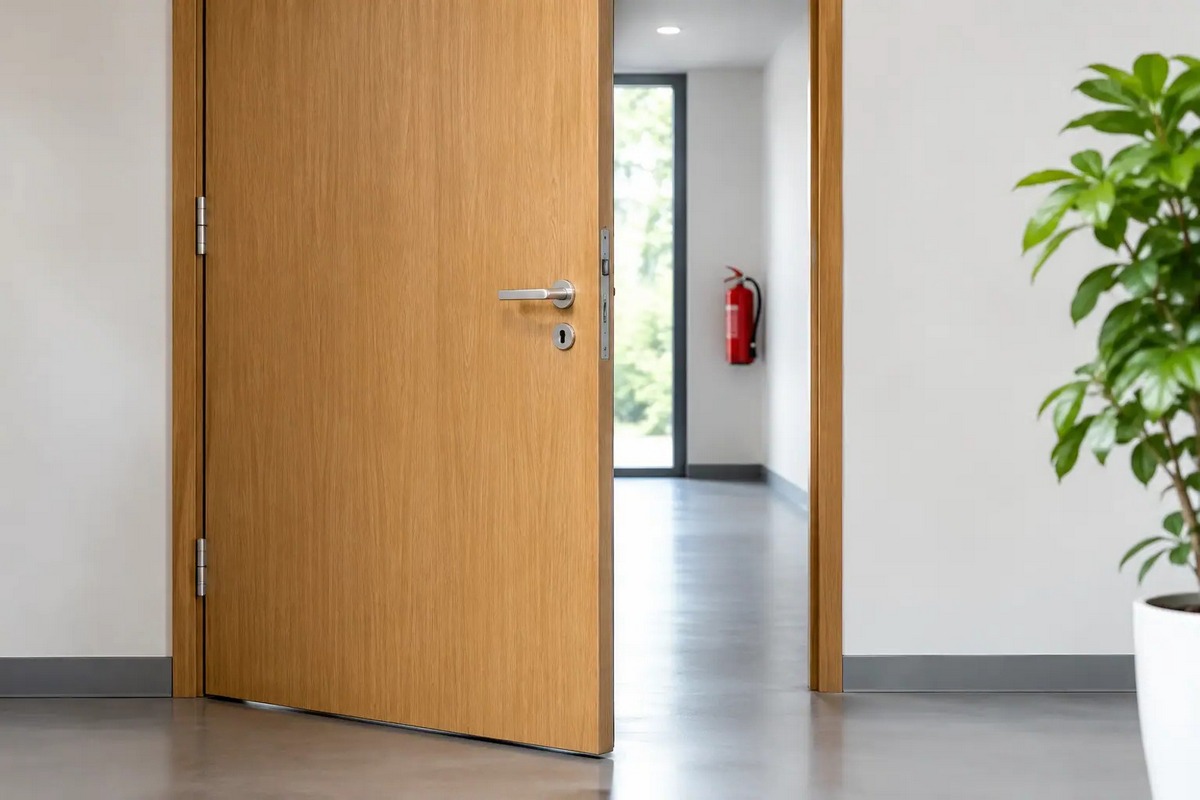
Learning how to determine swing of a door starts with choosing a viewing side, locating the hinges, and checking the opening direction. Record those details before buying a replacement or new hardware. A clear description helps prevent an order that fits the opening but operates the wrong way.
What is door swing / door handing
Door swing describes the path a hinged panel follows when it opens. Handing identifies its left or right configuration under a particular naming convention. Together, these details tell a supplier how the door operates within its frame.
A slab is the moving panel; a prehung unit includes the panel already mounted in a frame. Handing can affect hinge preparation, latch positioning, and hardware selection. For an existing frame, matching the panel dimensions alone does not guarantee a suitable replacement.
This guide uses a fixed outside viewpoint for its LH, RH, LHR, and RHR descriptions. The hinge side determines left or right, while movement toward the viewer adds “reverse.” Stay on that reference side even when the panel opens toward you.
Supplier terminology can differ, particularly between residential door catalogs and hardware charts. Match your observations to the diagram for the exact product before ordering.
Details worth recording
Keep these observations together so another person can understand the opening without visiting your home.
- Reference side: Identify where you stood, such as the porch, hallway, or bedroom.
- Hinge location: Record the left or right edge as viewed from that position.
- Opening direction: Note whether the panel moves toward you or away from you.
- Product type: Specify a replacement slab, complete frame assembly, or hardware component.
A photo helps explain an unusual layout. Include the surrounding wall and label the viewing side rather than sending an isolated closeup of the handle.
How to determine door swing: step-by-step
Inspect the existing door before removing its hinges or hardware. Keep the opening clear so you can move the panel without hitting furniture. These steps describe an ordinary hinged door that opens in a single direction.
Step 1: Choose the reference side
For a home entrance, start outside the house facing the doorway. For a bedroom or bathroom, the hallway usually provides the outside reference. If the opening connects similar rooms, identify your chosen side explicitly and confirm it with the supplier.
When learning how to tell a door swing, changing viewpoints halfway through the inspection is an easy mistake. Label the reference side in your notes before moving anything. Keep using that position for the remaining observations.
Step 2: Locate the hinges
Identify the edge where the panel attaches to the frame. Open it slightly if necessary to see the hinge leaves or pivoting edge. From your reference position, record whether that edge is on the left or right.
The handle usually sits opposite the hinges, but its position alone leaves the viewing side unclear. Concealed hinges may require a closer inspection. Avoid guessing from decorative panels, glass placement, or the direction a lever points.
Step 3: Check the opening direction
Operate the handle and move the panel slowly. Record “away from me” if you push it open and “toward me” if you pull it open. For an exterior entrance, also note whether it opens into the house or onto the porch.
Understanding how to tell which way a door swings requires recording that movement separately from the hinge location. A panel can have the same hinge side as another door yet open in the opposite direction. Both observations belong on your order notes.
Step 4: Match the supplier’s diagram
Compare your notes with the chart supplied for the product you intend to buy. Check where its viewer stands before comparing left and right. Some diagrams show the opening from above, so identify the labeled inside and outside areas first.
Use a description such as “viewed from the porch, hinges left, opens into the house” alongside the requested code. Ask the seller to resolve any disagreement between the drawing and your notes before fabrication. Keep the approved configuration with your measurements and order confirmation.
How to tell if a door swings left or right
The following examples use the same outside viewpoint throughout. Imagine standing in front of the closed panel with the room or house beyond it. Reverse describes movement toward you from that position.
If an order form labels a field “door swing right or left”, check the accompanying illustration before choosing. The wording may omit the viewing position. A sketch showing the hinge edge and opening arc removes that ambiguity.
What is a left-hand door (LH)?
Under this guide’s convention, an LH door has hinges on your left and opens away from you. The handle is on your right. Viewed from above, the free edge moves into the space beyond the doorway while the left edge remains attached.
For a bedroom example, stand in the hallway and push the panel into the room. Consider where it rests when open: a dresser or projecting shelf can obstruct its path even when the handing is correct.
What is a right-hand door (RH)?
An RH door has hinges on your right and opens away from you. Its handle sits on your left. It mirrors the LH arrangement from the same viewing position.
At a front entrance, this example opens into the house with the hinge edge on your right as you face inward. Check the entry area with the panel open, especially if a shoe cabinet or bench sits nearby.
What is a left-hand reverse door (LHR)?
An LHR door has hinges on your left but opens toward you. The hinge side stays left because your reference position has not changed. You pull the panel into the space where you are standing.
A shallow closet may use this arrangement to preserve storage space inside. The opening arc then occupies part of the adjoining room or hallway, which needs enough clearance for normal use.
What is a right-hand reverse door (RHR)?
An RHR door has hinges on your right and opens toward you. The handle remains on your left. Here, too, the reverse designation describes movement relative to the fixed outside viewpoint.
Check both the open panel and the person operating it when assessing clearance. A door that clears furniture can still leave someone standing awkwardly against a wall or another doorway.
Interior door swing vs. exterior door swing
Location affects how an opening serves the home. Indoor layouts emphasize access and available floor space. Outside entrances also need suitable weather protection and security hardware.
Plan around rooms and hallways
An interior door swing should leave useful access to the room without colliding with furniture, plumbing fixtures, or neighboring doors. Many bedroom doors open inward, while shallow closets often open outward. Bathrooms require attention to available space and access needs rather than a blanket rule.
Test the whole opening arc before changing the arrangement. Check whether a person can reach the light switch and move past the open panel comfortably. Include handles and wall stops in your assessment, since they project beyond the slab.
Consider the complete entrance assembly
An exterior door swing must work with the threshold, seals, hinges, and available landing space. Residential entrances may open inward or outward depending on the specified system. Neither direction alone establishes security or weather performance.
An outward opening unit needs hardware suitable for its exposed conditions. Changing an existing entrance’s direction can also require frame and threshold changes. Have the installer evaluate the complete opening before treating the change as a hinge adjustment.
Distinguish hinged and sliding products
Sliding patio doors travel along a track and need a different operating description. Identify the moving panel and the manufacturer’s viewing position when comparing configurations.
Columbia Windows offers sliding glass patio doors for homeowners in the Vancouver and Portland area. For a patio replacement, bring photos of the opening and discuss the preferred operating panel during your consultation.
How to determine door swing when the door is closed
You can often figure out door swing from a closed panel, but concealed hardware and unusual frames can make the result uncertain. Use visible features as clues. Confirm by opening the door when access becomes available.
Inspect the hinge edge and stop
On a conventional door with butt hinges, visible hinge barrels generally indicate that the panel opens toward you. The stop is the strip or formed ledge that the closed panel rests against. Its position can help establish the direction in which the panel is allowed to move.
Use this inspection sequence:
- Establish your position: Record which room or outside area you are standing in.
- Find the hinge edge: Look for barrels, hinge leaves, or visible attachment points.
- Examine the stop: Check which side blocks the panel from moving through the frame.
- Record uncertainty: Leave the code unconfirmed if the construction hides essential details.
Frame depth and decorative trim alone are unreliable indicators. Do not force a locked panel or remove hardware merely to establish handing.
Confirm unusual constructions
Pivot doors, concealed hinges, and panels that open in both directions need product-specific identification. A photograph of a closed door may not reveal enough to classify them. Use the manufacturer’s instructions or arrange an inspection instead of assigning a standard code from appearance alone.
Door swing chart (LH, RH, LHR, RHR)
Use this chart to determine door swing left or right under the fixed outside convention explained above. Every row assumes the same viewing side. Check your product’s ordering diagram before transferring a code onto its form.
| Handing Code | Full Name | Viewer Position | Hinge Location | Swing Direction | Possible Residential Use |
| LH | Left-Hand | Outside the room or building, facing the door | Left side | Swings inward (away from viewer) | Bedrooms, bathrooms, main front entries |
| RH | Right-Hand | Outside the room or building, facing the door | Right side | Swings inward (away from viewer) | Bedrooms, bathrooms, main front entries |
| LHR | Left-Hand Reverse | Outside the room or building, facing the door | Left side | Swings outward (toward viewer) | Reach-in closets, storm doors, coastal entries |
| RHR | Right-Hand Reverse | Outside the room or building, facing the door | Right side | Swings outward (toward viewer) | Reach-in closets, utility rooms, hinged patio entries |
Use the chart with your measurements
Handing is only part of a replacement specification. A slab also needs compatible dimensions, hinge preparation, and latch preparation for the existing frame. Measure these separately rather than assuming that matching the code guarantees a fit.
For several openings, label each photograph with a room name. Keep each set of dimensions beside its matching image. This prevents a correct observation from being assigned to the wrong doorway when you submit a combined order.